
When parents start looking for support for their child or teenager, there’s often a moment of hesitation. Not because they don’t want help, but because they’re unsure what kind of help is actually needed.
Do they need therapy? Coaching? Counselling? Or something else entirely? The language alone can feel overwhelming. But underneath the practical question is often a deeper worry:
“Is something wrong with my child?”
It’s very important to remember that seeking coaching does not mean something is broken.
Seeking therapy does not mean something has failed.
They serve different purposes.
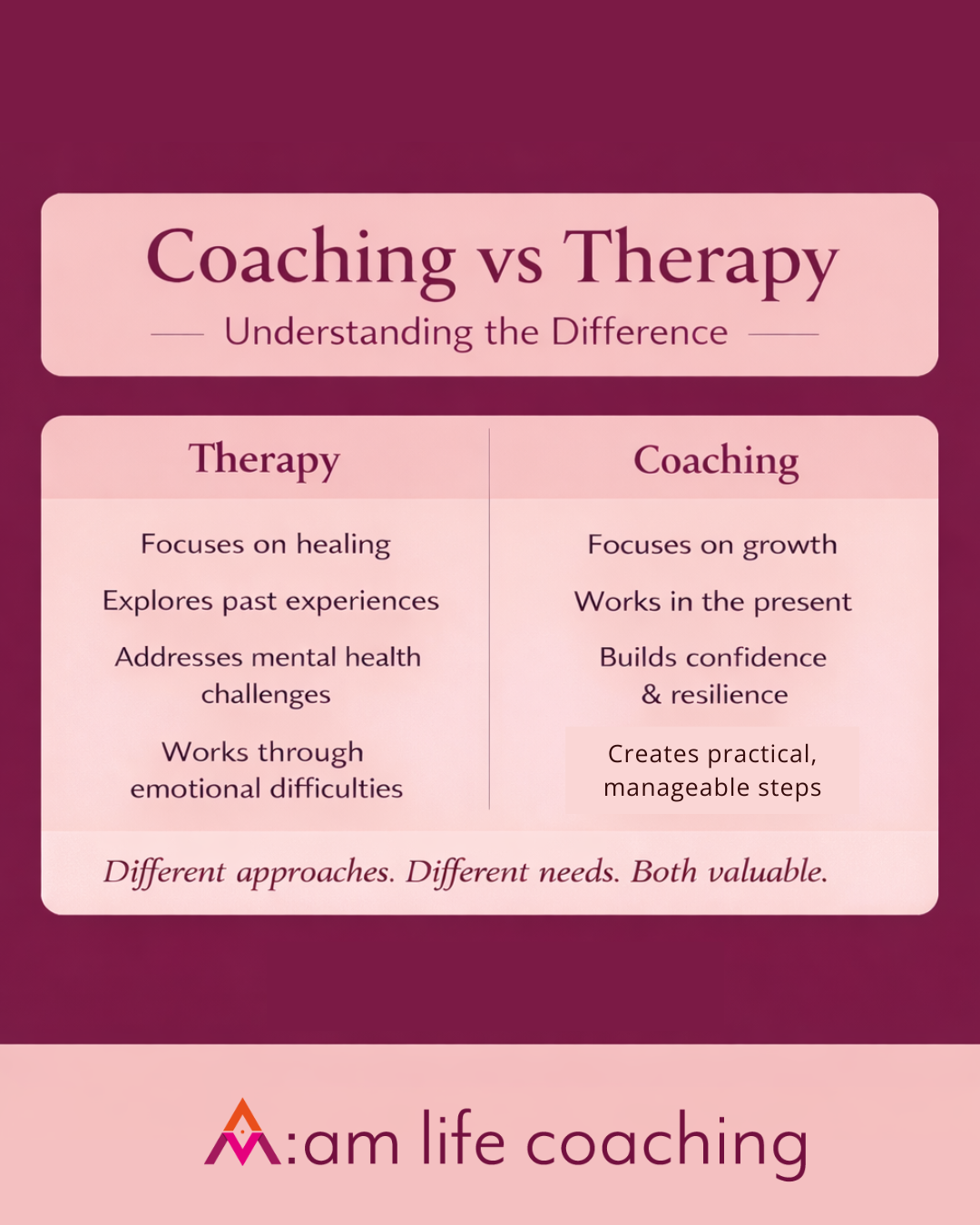
Therapy is about healing
Therapy is incredibly valuable and, in many situations, essential.
It provides a space to explore deeper emotional experiences, process difficult events, and work through psychological challenges. A therapist helps someone understand the roots of distress, unpack patterns shaped by the past, and address mental health concerns with clinical expertise.
For young people dealing with trauma, persistent anxiety, depression, or complex emotional struggles, therapy offers the kind of depth and care that supports real healing.
It’s not about quick solutions – it’s about understanding and recovery.
Coaching is about growth and forward movement
Youth coaching, however, takes a different – and often misunderstood – approach. It isn’t designed to diagnose, analyse or treat mental health conditions. Instead, coaching focuses on something many young people quietly struggle with:
How to manage the everyday pressures of growing up. Things like:
School demands.
Friendships.
Family dynamics.
Confidence dips.
Overwhelm.
Motivation struggles.
Stress that feels bigger than it should.
Coaching is less about asking “Why is this happening?” and more about asking “What would help you feel more capable moving forward?”
It’s practical, supportive, and rooted in building skills rather than treating problems.
Not fixing – but strengthening
One of the most important distinctions is that coaching is not about “fixing” a young person.
Most teens don’t need fixing. They need tools. Perspective. Confidence. Structure. They need someone outside the family dynamic who can help them untangle thoughts without judgement. They need accountability.
A coach works alongside them to develop manageable strategies:
How to cope with stress
How to build confidence
How to handle pressure
How to develop routines that actually stick
How to shift unhelpful thinking patterns
Small, realistic changes that build momentum over time.
A different kind of conversation
Why this distinction matters for parents
Parents sometimes hesitate around coaching because they worry it minimises mental health.
It doesn’t. In fact, coaching often acts as a powerful preventative support. It helps young people build resilience, emotional awareness, and coping skills before stress escalates into something heavier.
It’s about strengthening, not treating. And importantly – it helps remove the fear-based narrative that support only exists when something is “wrong.”
Can coaching and therapy work together?
Yes they can. They are not competing approaches and can be complementary. A young person may benefit from therapy for emotional healing and coaching for practical life skills, confidence building, or academic pressure.
Good coaching always respects boundaries and works ethically alongside other forms of support when needed.
So how do you know what your child needs?
Often, it comes down to the nature of the challenge. Is your child struggling with clinical mental health symptoms that require therapeutic care? Or are they feeling overwhelmed, stuck, uncertain, or lacking confidence in navigating everyday pressures?
Many young people simply need guidance, structure, and tools for coping with modern stressors.
That’s where youth coaching can be transformative.
Youth Coaching at AM Life Coaching
When I work with young people, they find a calm, non-judgemental space where they can:
- Build confidence
- Develop coping strategies
- Create manageable routines
- Strengthen resilience
- Feel heard without pressure
None of these are because they’re broken but because growing up is complex – and support helps.
If you take just one thing away from this it should be that therapy heals and coaching strengthens. Both are valuable. Both have their place. And choosing support isn’t a sign something is wrong – it’s a sign you’re paying attention. Learn more here about my approach to youth coaching, and please reach out if I can help you or your teen.